Polyploidization model

Dear NetLogo Community and Fellow Researchers,

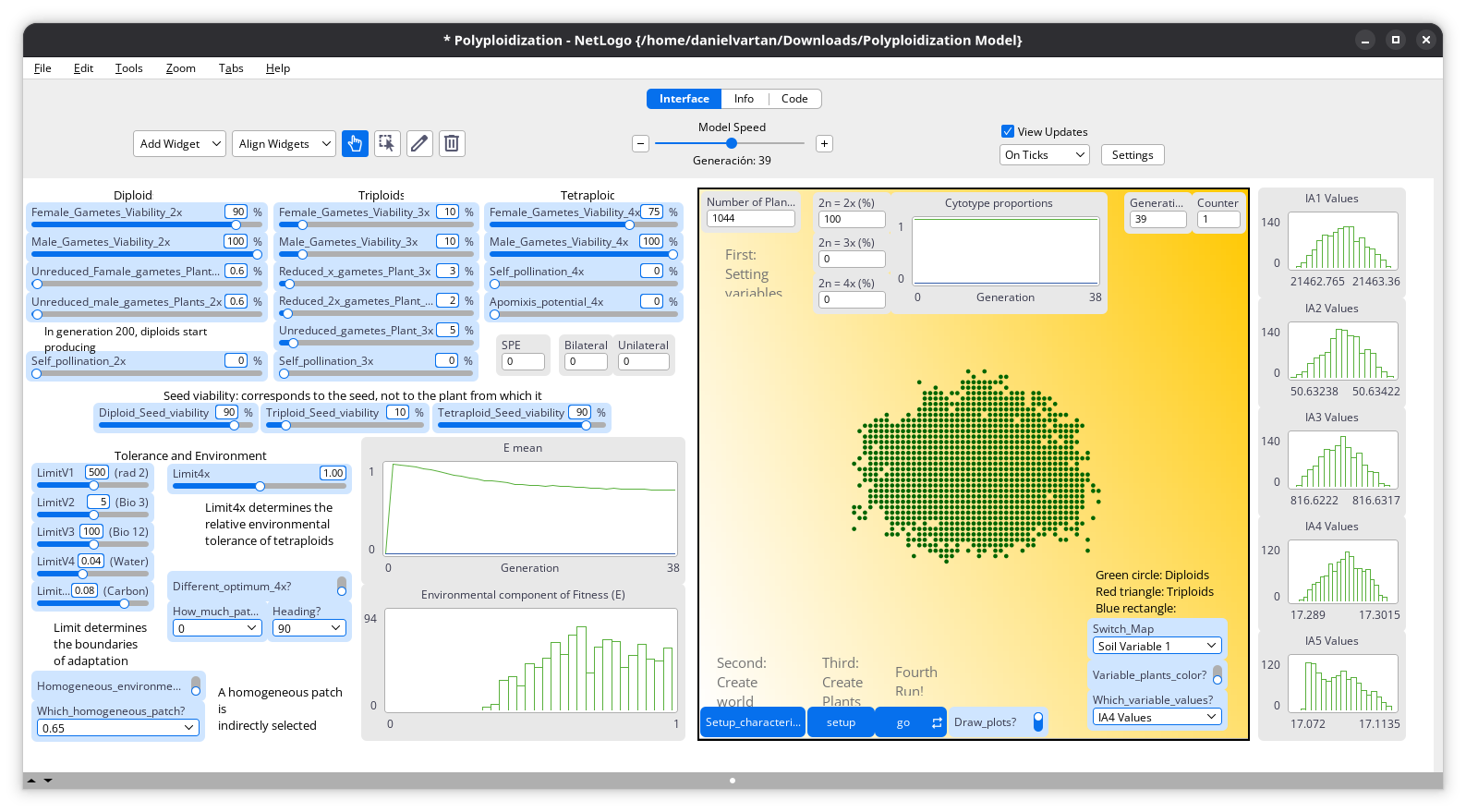
I am delighted to share a new agent model, designed to investigate the complex dynamics of diploid-polyploid interactions and the establishment of neopolyploids.

Model: Polyploidization model - Google Drive

Repository: http://hdl.handle.net/11336/253196

Article: https://doi.org/10.1038/s41598-025-29286-7

This model serves as a scalable, easy-to-use command center for analyzing the spatio-temporal dynamics of these evolutionary systems. It incorporates a multilayered environment where eco-variables fluctuate across generations, making the simulation highly responsive to environmental heterogeneity.

Key mechanisms within the model include the use of reproductive syndromes (like self-fertility and apomixis) and traits such as adaptivity, niche breadth, and dispersal.

Our preliminary analyses using this framework have provided clear, model-based evidence on several critical aspects: a large proportion of polyploidization events are unsuccessful, but factors like self-fertility, apomixis, and parental traits significantly accelerate establishment and demographic success. Furthermore, ecological niche shifts are shown to be vital for promoting cytotype coexistence.

My hope is that this NetLogo model will prove to be a valuable resource for your academic work, research projects, and teaching in the field of evolutionary and ecological modeling.

Please feel free to test the model, utilize it in your own research, and share any feedback or potential extensions you might consider. Your collaboration is highly valued.

Best wishes,
Juan Sebastián Schneider
2 Likes

Hi Sebastián,

Looks like a very cool model!

I just tried to download it, but the zip file seems to be corrupted. Could you please upload it again or share an alternative link?

I also recommend publishing the model on GitHub (see this) and on the CoMSES Network.

Thanks!

Hi Daniel,

Thanks for letting me know. I’ve shared the Drive access until I can correct the file on the official NetLogo website. (Model: Polyploidization model - Google Drive)

Best regards, and feel free to contact me here if you have any further questions.

1 Like

Hi Sebastián,

It’s working. Thank you!

I would like to suggest a few minor changes to make it easier for others to use your model.

  1. The input files are fairly small, so it might be better to include them as bundled resources. NetLogo 7 now allows data integration into nlogox files. By doing this, you could share just the nlogox file and the model would work, probably in NetLogo Web as well.
  2. Having two setup buttons is unusual and seems unnecessary. If someone does not click Setup_characteristics and only uses the setup button, the model throws an error. It would be better to integrate these actions into a single setup button.
  3. Is the Draw_plots? switch really necessary? The model is light, so performance does not seem to be an issue. I suggest either removing it or setting its default value to true.

Great job! I am still exploring the model and the article, but it looks very promising.

I have already shared it with some of my peers.

Cheers!

2 Likes

Thank you for the tips.

Some buttons have remained as a relict of the multiple tests we have carried out. Initially, we set up the world a single time, so that every time the model runs, it is not “created” again. This, like the blocking of graphics, saved a lot of time when we had to test a large number of experiments (in fact, the model is still “set” to run 1000 times before stopping).

To include the files as bundled resources is a great option, and I thank you for the suggestion. This model started to be created with previous versions of NetLogo.

Undoubtedly there will be many things that can be corrected, and I appreciate your comments. The goal is that anyone who finds it useful can use it, because that is what it is about, a tool.

Thank you again for your feedback, and I hope it can be of use to you.

Regards, Sebastián

2 Likes

Some buttons have remained as a relict of the multiple tests we have
carried out. Initially, we set up the world a single time, so that every
time the model runs, it is not “created” again. This, like the blocking
of graphics, saved a lot of time when we had to test a large number of
experiments (in fact, the model is still “set” to run 1000 times before
stopping).

I have used that trick too. You can add an IF statement to the 2nd setup
procedure that checks whether the world has been created (e.g., whether
some patch has 0 as its value of a variable that should be initialized)
and, if not, executes the first setup procedure.

To include the files as bundled resources is a great option, and I thank
you for the suggestion.

I had not noticed this new feature, so thank you.

But I do not see how to refer to a bundled file in your code. Do you
treat it as if it were a separate file in the same directory, use
FILE-OPEN, etc.?

Steve R.